
Alameda County Court Records After Arrest
After an Alameda County jail arrest, the jail record and court record serve different jobs. The ACSO Inmate Locator reflects sheriff custody and booking information. The formal criminal case is handled by the Superior Court of California, County of Alameda, after the District Attorney files a complaint or the case proceeds by indictment. Court records after a jail arrest can show the filed case number, hearings, charging documents, warrants, orders, dispositions, and sentencing events when public access allows.
The booking side is still useful because it gives identity clues and timing. For custody and jail search details, use Alameda County jail inmate records. For booking photos and photo access limits, use Alameda County jail mugshots. The court record is the better source for whether the prosecutor filed charges, whether charges changed, and whether an accusation ended in conviction, dismissal, diversion, or another result.
Find Court Records After Arrest
The court's public portals page separates criminal records from civil, family, and probate records. Criminal case records use the Alameda Superior Court criminal Odyssey portal and the Criminal Record Request Portal. The Odyssey notice says public access to Smart Search and Search Hearings requires registration. General public users should register, activate the account, and not select an elevated role.
The Alameda criminal Odyssey portal source page is shown below.
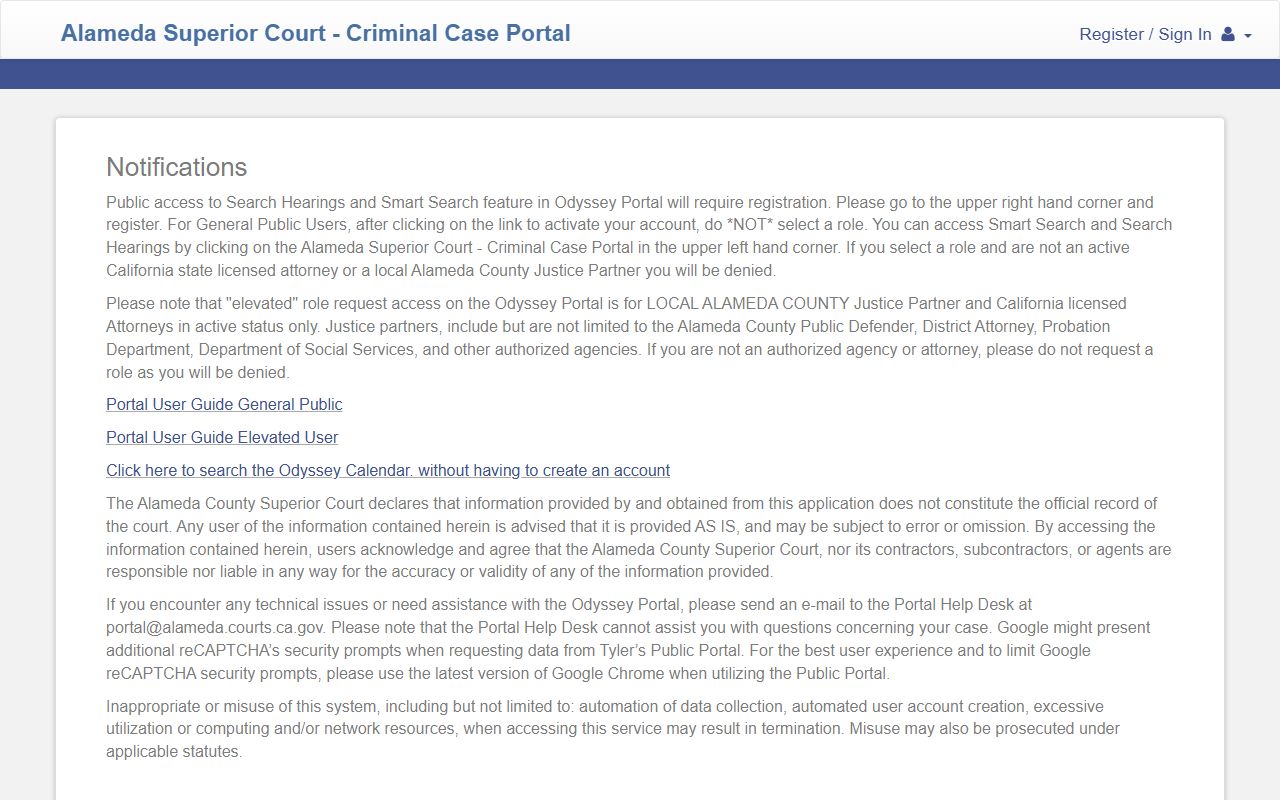
The portal notice confirms registration and the Smart Search/Search Hearings workflow, which is the core online court-record path after a jail arrest.
- Use the ACSO locator first to confirm name, PFN, booking date, and arresting agency when available.
- Register for the Alameda criminal Odyssey portal as a general public user.
- Search by party name or case number in Smart Search.
- Use Search Hearings for date-based hearing checks by party, case number, attorney, or judicial officer.
- If documents are not available online, use the Criminal Record Request Portal or a criminal records unit.
Alameda County Court Search Fields
The Odyssey portal is different from the jail roster. A PFN is a sheriff jail identifier, while court searches use case numbers, party names, hearing dates, attorney names, and judicial officer fields. The portal user guide noted that SSN may appear as an advanced parameter, but it is not available to users and does not return results for public access.
| Field Label | Type | Required | Notes |
|---|---|---|---|
| Register | Account workflow | Required for Smart Search/Search Hearings | General public users should not request elevated roles. |
| Smart Search | Search module | No | Search by party name or case number. |
| Search Hearings | Search module | No | Search by date range and hearing parameters. |
| Case Number | Text | No | Best when known from paperwork or court notice. |
| Party Name | Text | No | Defendant name search; access can vary. |
| Attorney Name | Text | No | Useful for hearing searches. |
| Judicial Officer | Text or dropdown | No | Used for hearing searches. |
Charges After Alameda County Arrest
Booking charges can differ from court charges. A booking charge is the arrest or warrant basis entered at jail intake. The Alameda County District Attorney reviews reports and decides whether to file a complaint, pursue an indictment, amend charges, or decline a charge. The Criminal Division is where a complaint is filed by the prosecuting agency, including the Alameda County District Attorney.
| Document | Filed By | Use in Alameda County Court Records |
|---|---|---|
| Complaint | Prosecutor | Common charging document that starts many criminal cases after arrest. |
| Information | Prosecutor | Felony charging document after preliminary-hearing proceedings. |
| Indictment | Grand jury | Grand jury charging document for serious or selected matters. |
The DA's December 16, 2025 release about the Maurice Monk in-custody death is an Alameda example of grand-jury indictment language. It also shows why court records after a jail arrest should be checked for the formal charging posture rather than relying only on an arrest or booking summary.
Alameda County Charge Status
A court charge is an accusation until resolved. Charges can be pending, amended, reduced, dismissed, enhanced, or resolved by plea, trial, diversion, or sentencing. The jail roster may show the arrest basis, but the court case tracks what is filed and what happens later. Court records also show missed appearances, warrants, protective orders, and bail changes when those events are public.
| Status | Meaning |
|---|---|
| Pending | The filed charge has not reached final disposition. |
| Amended | The prosecutor or court record changed the charge language, count, or allegation. |
| Reduced | The charge level or offense was lowered from an earlier filing. |
| Dismissed | The charge was ended without conviction on that count. |
| Convicted | The case or count ended in a guilty plea, verdict, or other conviction result. |
Bail After Alameda County Arrest
California bail in Alameda County depends on state law, court schedules, judicial decisions, and case facts. Government Code section 7923.610 includes the amount of bail set as public arrest information when no exception applies. The ACSO locator's Pending Release notice is also important: administrative release can take several hours, and another legal hold can stop release even after one issue appears resolved.
| Release Term | How It Works |
|---|---|
| Cash bail | Money is posted as allowed by the court or jail process. |
| Surety bond | A California bail agent posts bond for a fee. |
| Own recognizance | Release based on a promise to appear, without posting money. |
| No bail | Bail is not available at that stage or for that holding authority. |
| Hold or detainer | A warrant, parole, probation, federal, immigration, or state-prison authority can block release. |
Warrants in Alameda Court Records
No complete countywide active warrant search portal was found in ACSO materials. ACSO publishes a Most Wanted page, but that is a selected public-safety page, not a full warrant database. Alameda Superior Court says a person with a warrant should contact the courthouse that issued it or the proper law-enforcement agency. Court records after an arrest can show bench warrant events, warrant recalls, bail forfeiture, and failure-to-appear consequences when public access permits.
Criminal court fallback contacts in the research include Wiley W. Manuel Courthouse records at (510) 627-4700, Rene C. Davidson Courthouse at (510) 891-6009, Hayward Hall of Justice at (510) 690-2703, Fremont Hall of Justice at (510) 818-7501, and East County Hall of Justice records at (925) 227-6700.
Charges Versus Convictions
An Alameda County arrest or filed charge is not the same as a conviction. A charge is the accusation brought into court. A conviction is the result after a plea, verdict, or qualifying court finding. Court records after a jail arrest should be read in sequence, because the first charge list may not match the final case outcome.
| Point | Charge | Conviction |
|---|---|---|
| Stage | Filed accusation | Final or count-specific result |
| Proof | Based on filing standards and probable cause | Based on plea, verdict, or court finding |
| Can change? | Yes, charges may be amended, reduced, or dismissed | Can be affected by appeal, relief, or later court orders |
Sealed Alameda County Arrest Records
California Penal Code section 851.91 allows a person whose arrest did not result in conviction to petition to seal arrest and related records. California Courts self-help also notes automatic DOJ sealing under Penal Code section 851.93 in some situations. Sealing is not the same as deleting every mention from every government or third-party system, and it does not turn a booking event into a conviction.
| Record Relief | What It Means | Limit |
|---|---|---|
| Sealed arrest | Public access to qualifying arrest records is restricted. | Law-enforcement and court access may still exist by law. |
| Expungement-style relief | California relief can change how a conviction is reported or used. | It is not a blanket deletion of all public facts. |
| Confidential record | Juvenile, sealed, protected, medical, victim, or investigation data may be withheld. | Access depends on statute and court order. |
Restricted Alameda County Court Records
Not every court record after a jail arrest is open online. Alameda Superior Court states that online access does not include every document and confidential records are restricted. The court records page also says the court does not provide research by telephone or email, so a requester may need online ordering, mail research, public access terminals, or help from the proper criminal division. Older felony cases before 1974 require special assistance through criminal divisions or the California DOJ route described by the court.
Important: These court and custody records are not consumer reports and may not be used for FCRA-covered decisions.